
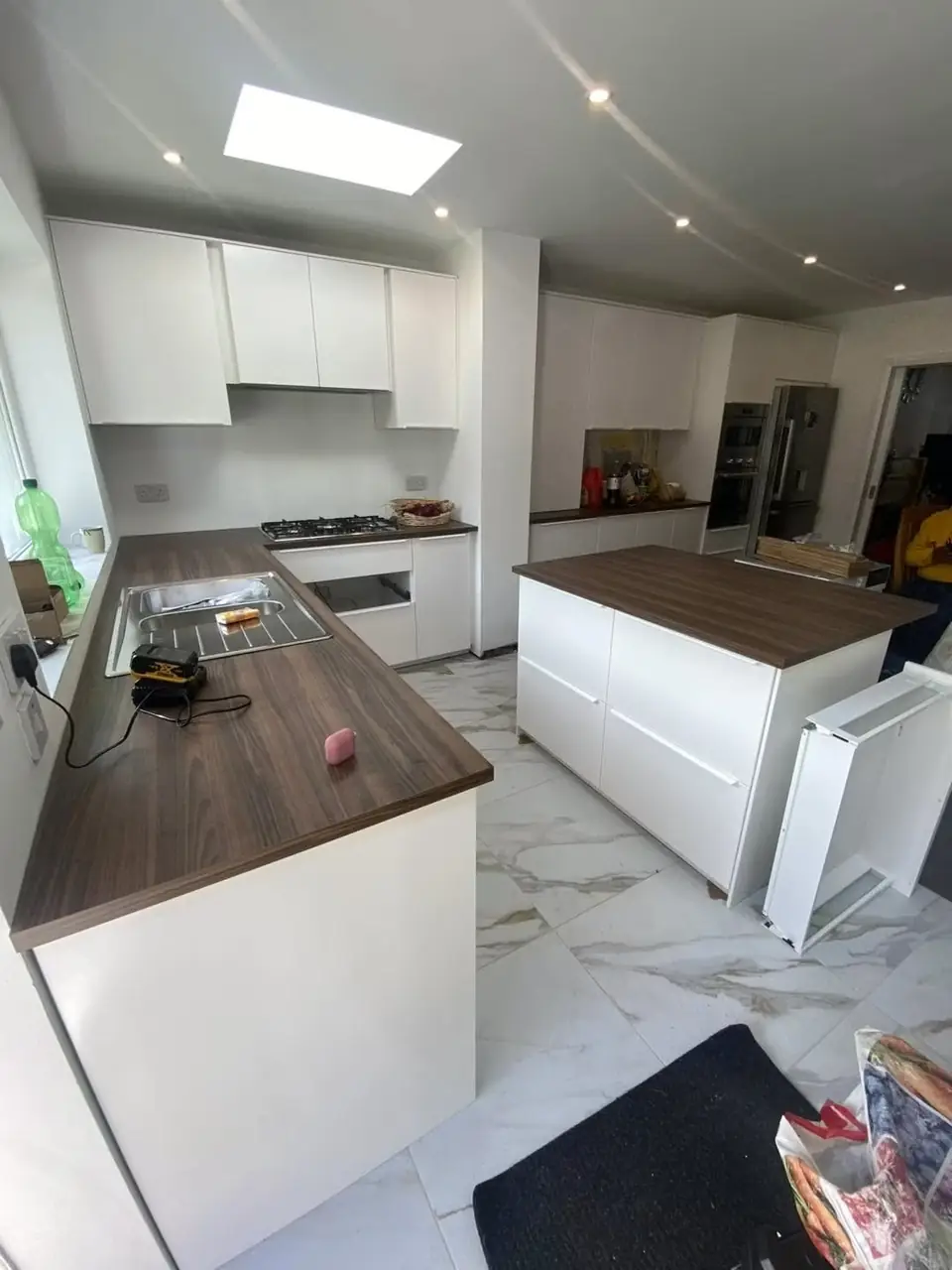

Quick answer
A gas hob must be connected by a Registered Gas Installer (RGI), who issues a Declaration of Conformance. A new or replaced cooker circuit for an electric oven or hob is Restricted Works for a Registered Electrical Contractor (REC), who issues a Completion Certificate. Your kitchen fitter fits the appliances into their housings and cut-outs.
Key takeaways
- The CRU says gas installers and electrical contractors must be registered to work in Ireland: it is the law.
- An RGI must issue a completion certificate for all gas works; CERT 3 covers appliance fits on an existing meter (RGI scheme).
- Installing or replacing one or more circuits in a home is Restricted Works, for a REC only (Safe Electric, S.I. No. 264 of 2013).
- Restricted Works have applied since 1 October 2013; unregistered parties face prosecution (Safe Electric).
- IKEA Ireland's own installers fit appliances with the electrical and gas connection not included.
- Safe Electric charges a minimum of €250 for a change of contractor inspection if the original REC cannot certify.
Yes or no
Can a kitchen fitter connect a gas hob? No, unless they are a Registered Gas Installer. Can a kitchen fitter wire a new cooker circuit? No, unless they are a Registered Electrical Contractor. Can a kitchen fitter fit the oven into its housing and the hob into the worktop? Yes, that is fitting work.
2 schemes
RGI for gas, Safe Electric for electrical contractors
CRU
1 October 2013
start of Restricted Electrical Works for RECs only
Safe Electric
€250
minimum change of contractor inspection fee
Safe Electric
A new kitchen brings an oven and a hob, and both need power or gas. Irish law splits who may make those connections. The rules are short once you see them laid out, and they decide which certificate you should hold when the kitchen is finished.
Who can connect a gas hob in Ireland?
Short answer
Only a Registered Gas Installer (RGI). The CRU says gas installers must be registered with the RGI scheme to work in Ireland, and that this is the law. After the work, the RGI must give you a Declaration of Conformance Certificate. For a hob on an existing gas supply, that is CERT 3.
The RGI scheme is run by the Gas Safety Supervisory Body for the CRU. It says the 2006 Act makes a completion certificate mandatory for all gas works. CERT 3 covers existing installations with a meter already fitted, including appliance fits, pipework, safety checks and repairs. The RGI hands you the original white copy straight after the work.
Who can connect an electric oven or hob?
Short answer
If the job installs or replaces a circuit, only a Registered Electrical Contractor (REC). Safe Electric defines that as Restricted Works in a home. A REC must issue a Completion Certificate for all electrical works except minor works, and must certify minor works too if you ask.
Safe Electric lists what falls outside Restricted Works. Its examples of minor works are like-for-like replacements such as switches, moving light fittings without affecting the circuit, and adding a socket to an existing circuit. The HSA notes that this kind of work must still comply with the technical rules. Safe Electric’s own advice is to always use a REC for electrical work in your home.
| Job | Who | Certificate |
|---|---|---|
| Connect, move or cap a gas hob or cooker | RGI | Declaration of Conformance (CERT 3) |
| New or replaced cooker or hob circuit | REC (Restricted Works) | Completion Certificate |
| New consumer unit or distribution board work | REC (Restricted Works) | Completion Certificate |
| Minor works, such as like-for-like swaps | Best done by a REC | Certified on request |
| Oven into housing, hob into cut-out | Kitchen fitter | None |
| Water to the sink, dishwasher and washer | Plumber | Invoice |
What does a kitchen fitter do with the oven and hob?
Short answer
The physical fitting. That means building the oven housing, fixing the oven into it, cutting the hob opening in the worktop to the maker’s template, and setting the hob in place. IKEA Ireland’s own installers work the same way: appliances are installed with the electrical and gas connection not included.
Our kitchen fitting service follows that line. We fit appliances into their housings and cut-outs, and the registered trades make the connections. We are not registered for gas or electrical work.
In what order should the trades come?
Short answer
Registered trades first to make old services safe or run new ones, then the fitter, then the trades again to connect. A hob cannot be connected until the worktop and cut-out are in, so book the RGI or REC for after the worktops, and for after the stone is fitted if you chose stone.
| Stage | Who | What you get |
|---|---|---|
| Old gas capped, old circuit made safe | RGI, REC | Certificate for the work |
| New circuit or gas pipe run to the new position | REC, RGI | Certificate for the work |
| Housings built, worktop and cut-outs made | Kitchen fitter | Appliances in place |
| Hob and oven connected and tested | RGI, REC | Declaration of Conformance, Completion Certificate |
Our guide on how long it takes to fit a kitchen shows where each visit falls in the week.
Planning a new kitchen?
We fit the units, oven housing and hob cut-out, ready for your RGI and REC.
How do you check an installer is registered?
Short answer
Ask to see the card or search the register. Every RGI carries an ID card renewed yearly, numbered Rxxxx, with a photo, the year and a QR code. Safe Electric runs a search for RECs by county and Dublin postcode. Both schemes can be reached on 091 480974.
- Check the RGI card shows the current year
- Search the REC by name on Safe Electric before the work starts
- Agree in writing that a certificate will be issued
- Keep the certificates with your house papers for a future sale
What are the risks of unregistered work?
Short answer
Safety first, then paperwork. The CRU prosecutes unregistered gas installers and electrical contractors. Safe Electric says unregistered parties doing Restricted Works will be subject to prosecution. Without a certificate, you have no record that the connection was tested to the national standard.
- No certificate: a REC’s certificate confirms the work was tested and its safety verified, according to the HSA
- Changing contractor later: Safe Electric charges at least €250 for a change of contractor inspection when the original installer cannot certify
- Reporting: both schemes take reports of illegal gas or electrical work
For the rest of the kitchen budget, see kitchen fitting cost in Dublin. If you are using IKEA’s fitters, the same rules apply, as our IKEA installation versus your own fitter guide explains.
Need a price for kitchen fitting?
Send the plan or a photo and we will price it.
Frequently asked questions
Can my kitchen fitter connect the hob?
Only if they are registered for that work. A gas hob needs a Registered Gas Installer. Wiring a new or replaced cooker circuit needs a Registered Electrical Contractor. A fitter who is neither can fit the hob into the worktop cut-out, but the connection is for the registered trade. We are not registered for gas or electrical work.
Do I need a certificate for a new oven?
If a REC installs or alters a circuit, they must give you a Completion Certificate. Safe Electric says minor works such as like-for-like replacements fall outside Restricted Works, but a REC must still certify them if you ask. For gas ovens and cookers, the RGI issues a Declaration of Conformance.
How do I check that a gas installer is registered?
Every RGI carries an ID card renewed each year, with an ID number in the format Rxxxx, a photo, the current year and a QR code linking to the RGI website, according to the RGI scheme. You can also search the register on rgi.ie or call 091 480974.
How do I find a Registered Electrical Contractor?
Safe Electric runs a search by county and Dublin postcode on its website. It advises always using a REC for electrical work in your home and asking for a Completion Certificate when the work is finished.
What if a gas installer or electrician will not give me a certificate?
Both schemes take complaints. The RGI scheme asks you to complete its complaint form if an installer refuses to issue a certificate, and Safe Electric does the same for a REC. Do not use a gas appliance you are unsure about.
Who connects the sink and dishwasher?
A plumber. IKEA's installation service fits the sink and tap and connects the waste, but leaves the plumbing connection out. Book a plumber for after the sink and appliances are in place, and ask for an itemised invoice.
Next steps
How we checked these figures
We used primary sources only: the Commission for Regulation of Utilities, Safe Electric, the Health and Safety Authority, the RGI scheme run by Safe Energy Ireland, and IKEA Ireland for what a kitchen installer does and does not connect. Every page was loaded on 19 November 2026 and each rule checked against its text. This guide explains the rules; it is not legal advice, and the registered trade on your job decides how the work must be done.
Where the numbers come from
- RGI and Safe Electric schemes, Commission for Regulation of Utilities, checked 19 November 2026
- Restricted and controlled electrical works, Safe Electric, checked 19 November 2026
- Completion certificates, Safe Electric, checked 19 November 2026
- Find a Registered Electrical Contractor, Safe Electric, checked 19 November 2026
- Works needing certification, Health and Safety Authority, checked 19 November 2026
- Declaration of Conformance Certificates (Completion Certificates), Registered Gas Installers (Safe Energy Ireland), checked 19 November 2026
- Registered Gas Installers (RGIs), Registered Gas Installers (Safe Energy Ireland), checked 19 November 2026
- Kitchen installation service, IKEA Ireland, checked 19 November 2026